Koenigsegg: The Full Story — Why It's the World's Most Extreme Hypercar, How Rare It Is & Why It's Worth Every Penny (2026)
Fewer than 450 cars built in 24 years. A CC8S worth $3.2 million. A 277.9 mph world speed record. The complete story of Koenigsegg — from a 22-year-old's dream in a Swedish farmhouse to the 1,600 hp Jesko Absolut that may be the fastest road car ever built.
Advertisement
1. The Origins: A 22-Year-Old's Impossible Dream
In 1994, Christian von Koenigsegg was 22 years old, living in Sweden, and had never built a car in his life. He had no engineering degree, no factory, no investors, and no team. What he had was a vision: to build the world's fastest and most technologically advanced road car. Most people who heard the idea laughed. Nobody laughed for long.
Born in Stockholm in 1972, Christian grew up watching a Norwegian children's film called Flåklypa Grand Prix — a stop-motion animation about a bicycle repairman who builds a racing car and wins the Grand Prix. He watched it obsessively. At age 22, he decided to do the same thing, but for real. He sold his apartment, borrowed money from friends and family, and began sketching what would become the Koenigsegg CC (Competition Coupe). [1]
The first prototype, the CC, was completed in 1996 using a Ford V8 engine. It was crude but fast. Christian drove it to car shows across Europe, collecting feedback and refining the design. In 1997, he secured a lease on a former Swedish Air Force base in Ängelholm — a facility that had housed the Draken jet fighter — and began building the company properly. The location was symbolic: a place built for speed, now repurposed for a different kind of record-breaking machine.
By 2000, Koenigsegg had developed its own 4.7-litre supercharged V8 engine, producing 655 hp. The company employed 12 people. Christian had spent six years and every penny he had. The car was ready. Now he needed to sell it. [2]
"I wanted to build the best car in the world. Not the most expensive. Not the most exclusive. The best."
— Christian von Koenigsegg
What made Koenigsegg different from the start was vertical integration. While Ferrari buys its gearboxes from Getrag and Lamborghini sources its engines from Audi, Koenigsegg designs and builds almost everything in-house: the engine, the gearbox, the carbon fibre monocoque, the wheels, the exhaust system, and even the infotainment software. This approach is extraordinarily expensive — it requires a team of engineers that would be more at home at a Formula 1 team than a boutique car manufacturer — but it gives Koenigsegg a level of technical control that no other hypercar maker can match. [3]
2. The CC8S (2002): The Car That Started Everything
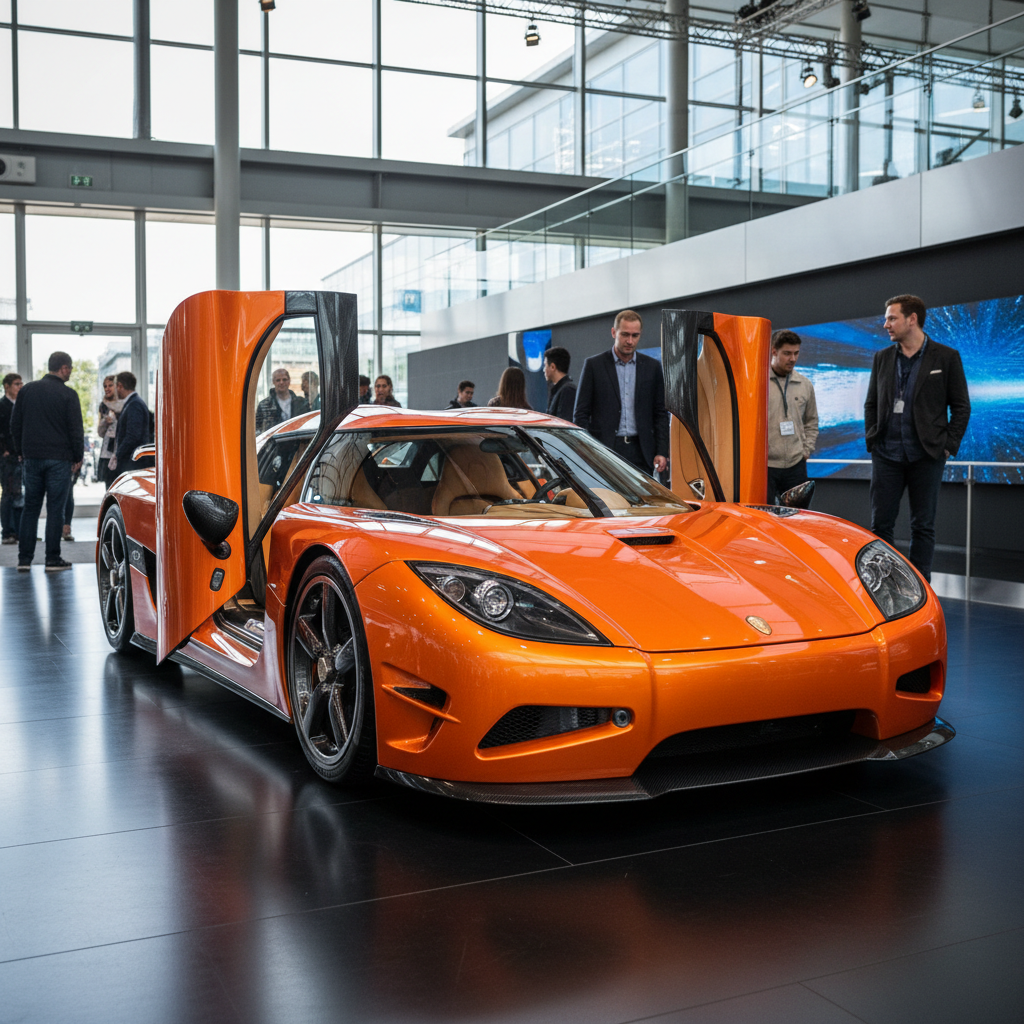
The Koenigsegg CC8S (Competition Coupe, 8-cylinder Supercharged) was unveiled at the 2002 Geneva Motor Show. It was the first road-legal Koenigsegg and the first production car to be officially homologated for road use by the Swedish authorities. The specification was staggering: 655 hp from a 4.7-litre supercharged V8, 0–60 mph in 3.2 seconds, and a top speed of 242 mph (389 km/h) — making it the fastest production car in the world at the time. [4]
Only six CC8S cars were built. The price was $654,000 — more than a Ferrari Enzo, more than a Lamborghini Murciélago, more than almost anything else on the market. But the performance justified it. The CC8S was faster than the McLaren F1 in a straight line, and it came with a full leather interior, air conditioning, and a removable hardtop that stored under the bonnet. Christian von Koenigsegg had built a car that was simultaneously the fastest and one of the most practical hypercars in the world.
Today, a CC8S in good condition is worth $3–3.5 million — a return of approximately 17.2% per year since 2002. With only six examples in existence, the market is essentially non-existent: when one comes up for sale, it typically sells within days to a collector who has been waiting for years. [5]
The CC8S introduced several technologies that Koenigsegg would refine over the next two decades. The carbon fibre monocoque — designed entirely in-house — weighed just 65 kg and was stiffer than a Formula 1 chassis. The dihedral synchro-helix doors (which open upward and outward simultaneously) became a Koenigsegg trademark. The removable hardtop, which stores in the front boot, solved the classic supercar problem of having nowhere to put the roof. [6]
3. CCR & CCX Era (2004–2010): Breaking World Records
The CCR (Competition Coupe R) arrived in 2004 with a 806 hp version of the supercharged V8 — achieved by adding a second supercharger. On 28 February 2005, a CCR set a new Guinness World Record for the fastest production car: 241.63 mph (388.87 km/h) at the Nardo Ring in Italy, beating the McLaren F1's 240.1 mph record that had stood for nine years. Koenigsegg had arrived on the world stage. [7]
Only 14 CCRs were built. The price was $655,000. Today, a CCR is worth $2.5–3 million — a CAGR of approximately 14.6% since 2004. The car is particularly sought after by collectors because of its world record status and its role in establishing Koenigsegg as a serious competitor to Ferrari, Lamborghini, and Bugatti.
The CCX (Competition Coupe X, for the 10th anniversary of the company) arrived in 2006 with a new engine: a 4.7-litre twin-supercharged V8 producing 806 hp on regular 91-octane fuel and 1,018 hp on E85 biofuel — making it the first production car to exceed 1,000 hp on a commercially available fuel. The CCX was also designed to meet US safety regulations, opening the American market for the first time. [8]
Twenty-nine CCXs were built, along with six CCXR (biofuel) variants. The CCXR Edition — two cars built — was listed by Forbes as one of the world's most expensive cars at $2.1 million in 2009. The CCXR Trevita (three built, using a unique white carbon fibre weave that Koenigsegg developed in-house) was priced at $4.8 million and is now worth $8–10 million. Floyd Mayweather famously owned one. [9]
Koenigsegg Top Speed Records (2000–2026)
Source: Guinness World Records, Koenigsegg Automotive AB [10]
Figure 1: Koenigsegg top speed progression by model year. The Agera RS's 277.9 mph (2017) remains the verified production car record.
4. The Agera Era (2011–2018): 277.9 mph
The Koenigsegg Agera (Swedish for "to act" or "to take action") debuted at the 2011 Geneva Motor Show and won the award for Most Innovative Supercar. It introduced Koenigsegg's new in-house 5.0-litre twin-turbocharged V8 — the first engine entirely designed and built by Koenigsegg, with no external supplier involvement. The engine produced 940 hp in standard form and 1,140 hp on E85 biofuel. [11]
The Agera R (2011–2014) pushed output to 1,140 hp on E85 and set multiple Guinness World Records: 0–300 km/h in 14.53 seconds (beating the Bugatti Veyron Super Sport by 1.5 seconds), 300–0 km/h in 6.66 seconds, and 0–300–0 km/h in 21.19 seconds. The Agera S (for markets without E85 availability) produced 1,030 hp on 95-octane fuel. [12]
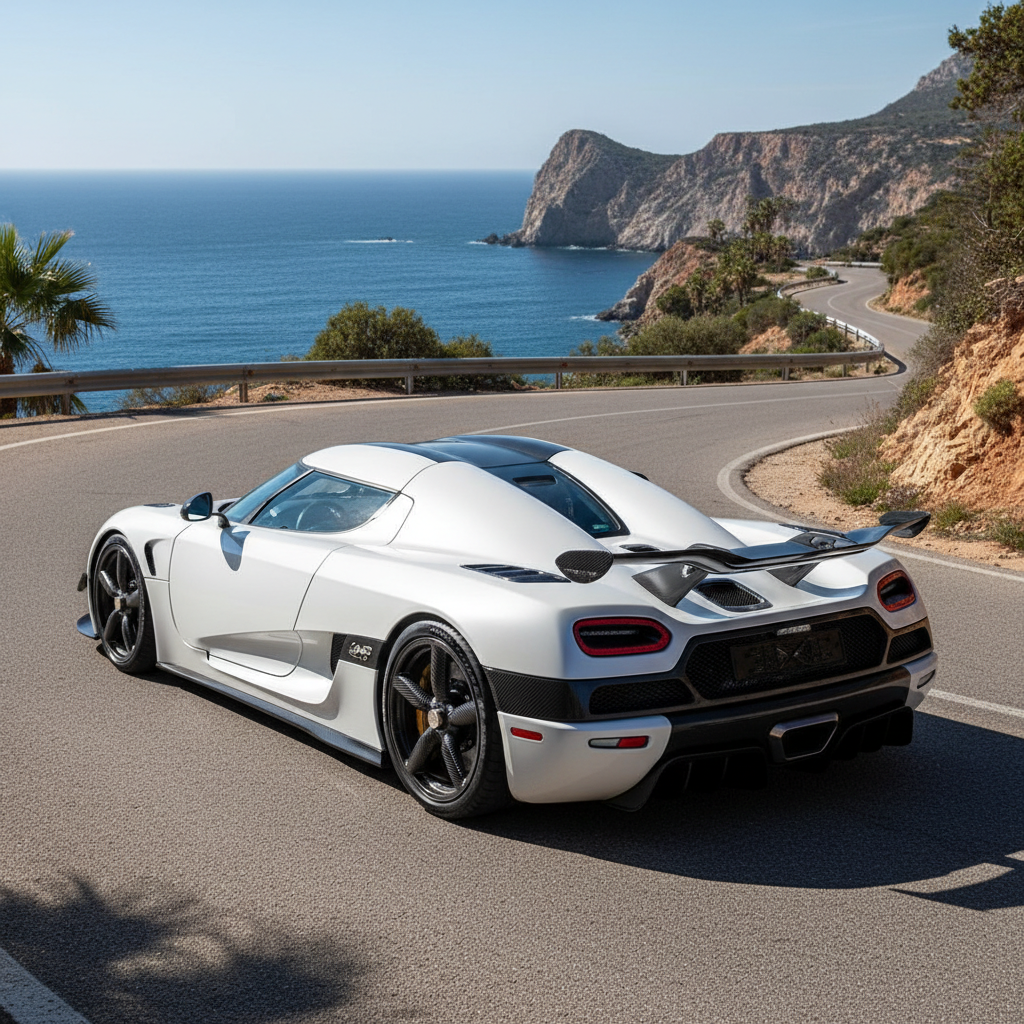
But the defining moment of the Agera era came on 4 November 2017, on a closed section of Nevada State Route 160 near Las Vegas. A Koenigsegg Agera RS — one of 25 built — achieved an average two-way speed of 277.9 mph (447.2 km/h), setting a new Guinness World Record for the fastest production car. The peak speed on one run was 284.55 mph (457.9 km/h). The record was verified by Guinness World Records and has not been beaten by any production car since. [13]
The Agera RS was priced at $2.5 million. All 25 were sold before the car was officially announced. Today, an Agera RS is worth $6–7 million on the secondary market — a return of approximately 15.8% per year since 2015. The One:1 — seven cars built (one for each megawatt of power, hence the name, with a 1:1 power-to-weight ratio of 1,360 hp and 1,360 kg) — is worth $8–10 million, having been priced at $2.8 million in 2014. [14]
The Agera era also saw Koenigsegg develop the "Hundra" (Swedish for "hundred") — a special edition Agera R built to celebrate the company's 100th car. It was painted in a unique white and gold livery and featured a bespoke interior with gold-plated components. It sold for $2.1 million in 2013 and is now worth approximately $5 million. [15]
5. The Regera (2016–2020): The Hybrid Hypercar That Rewrote the Rules
The Koenigsegg Regera (Swedish for "to reign") was unveiled at the 2015 Geneva Motor Show and immediately became the most technically complex road car ever built. The powertrain combined a 5.0-litre twin-turbocharged V8 producing 1,100 hp with three electric motors producing a combined 700 hp — for a total system output of 1,500 hp. But the truly revolutionary element was the drivetrain: the Regera has no conventional gearbox. [16]
Instead, Koenigsegg developed the "Koenigsegg Direct Drive" (KDD) system — a single-speed transmission that uses the electric motors to fill the torque gaps that a conventional gearbox would normally address. The result is seamless, instantaneous acceleration from 0 to 400 km/h (249 mph) in 20 seconds — a figure that no other production car has matched. The 0–400 km/h time was verified by Guinness World Records in 2016. [17]
Only 80 Regeras were built, each at $1.9 million. The car was sold out before production began. Today, a Regera is worth $5–5.5 million — a return of approximately 13.2% per year since 2016. The Regera is particularly significant as a collector car because it represents a unique moment in automotive history: the first hypercar to successfully combine a combustion engine with electric motors in a way that enhanced rather than compromised the driving experience. [18]
6. The Jesko & Gemera (2020–Present): The Future of Koenigsegg
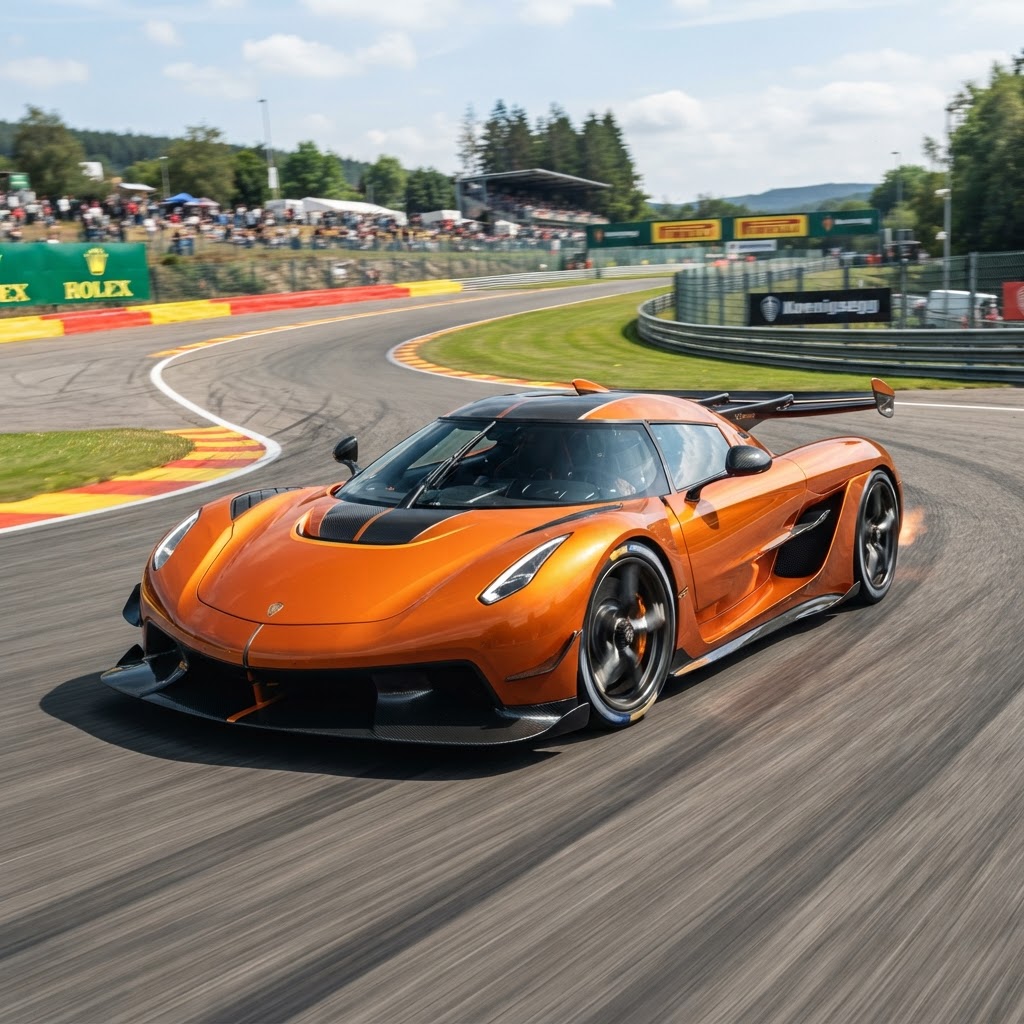
The Koenigsegg Jesko was unveiled at the 2019 Geneva Motor Show, named after Christian von Koenigsegg's father, Jesko von Koenigsegg, who provided crucial early funding for the company. The Jesko is powered by a new 5.0-litre twin-turbocharged V8 producing 1,280 hp on 95-octane fuel and 1,600 hp on E85 biofuel — the highest output of any road-legal production car engine at the time of its announcement. [19]
The Jesko's most significant innovation is the Light Speed Transmission (LST) — a 9-speed multi-clutch gearbox that can change gear in under 1 millisecond, faster than any other transmission in production. The LST has nine clutches and can skip multiple gears simultaneously, selecting the optimal ratio for any driving situation. It took Koenigsegg eight years to develop. The Jesko Attack (track-focused) produces 1,600 hp and generates 1,000 kg of downforce at 275 mph. The Jesko Absolut (top speed variant) is claimed to be capable of 330 mph (531 km/h). [20]
Only 125 Jescos were built, each at $2.8 million. All were sold before the car was unveiled. The CC850 — unveiled in 2022 to celebrate the company's 50th anniversary (counting from Christian's 1972 birth year) — is limited to 50 units at $4.5 million each, making it the most expensive Koenigsegg ever offered. It combines the new 1,385 hp V8 with a unique "Engage Shift System" that allows the driver to choose between a fully automatic mode and a manual mode with a traditional H-pattern gearbox. [21]
The Gemera — unveiled alongside the Jesko in 2019 — is perhaps the most extraordinary car Koenigsegg has ever built. It is a four-seat, four-door grand tourer powered by a 2.0-litre three-cylinder "Tiny Friendly Giant" (TFG) engine producing 600 hp, combined with three electric motors for a total of 1,700 hp. It seats four adults in genuine comfort, has a 0–60 mph time of 1.9 seconds, and a claimed top speed of 250 mph. It is limited to 300 units at $1.7 million each. [22]
7. Why Koenigsegg Is So Expensive: The Full Cost Breakdown
A Koenigsegg Jesko costs $2.8 million. A Bugatti Chiron costs $3.3 million. A Pagani Utopia costs $2.4 million. But while Bugatti is backed by the Volkswagen Group's €250 billion balance sheet and Pagani uses AMG engines, Koenigsegg designs and builds almost everything in-house, with a team of fewer than 300 people. The economics are extraordinary.
In-House Engineering
Engine, gearbox, carbon fibre, wheels, exhaust, infotainment — all designed and built at Ängelholm. No external supplier for core components.
Tiny Production Volume
Fewer than 50 cars per year. Fixed costs (R&D, tooling, engineering) are amortised over a fraction of the units that Ferrari or Lamborghini produce.
Patented Technologies
Koenigsegg holds over 100 patents, including the LST gearbox, KDD direct drive, Freevalve camless engine technology, and the Triplex suspension system.
Carbon Fibre Mastery
Every body panel is hand-laid carbon fibre. The CCXR Trevita's unique white carbon weave required a new manufacturing process that cost millions to develop.
6–12 Months Per Car
Each Koenigsegg takes 6–12 months to build from order to delivery. The engine alone takes 400 hours to assemble. The interior takes 200 hours.
World Record Performance
The Agera RS holds the verified production car speed record. The Jesko Absolut claims 330 mph. Performance at this level requires aerospace-grade materials and tolerances.
The Koenigsegg engine programme alone illustrates the cost. The 5.0-litre twin-turbo V8 in the Jesko was developed over five years at a cost estimated at $50–80 million. It produces 1,600 hp from 5.0 litres — a specific output of 320 hp per litre, compared to 200 hp/litre for a Ferrari V12 and 150 hp/litre for a Bugatti W16. The engine block is machined from a single billet of aluminium. The crankshaft is forged titanium. The connecting rods are titanium. The pistons are forged aluminium with a ceramic thermal barrier coating. [23]
Koenigsegg also invests heavily in technologies that go beyond the cars themselves. Freevalve — a Koenigsegg subsidiary — has developed a camless engine technology that replaces the traditional camshaft with individual pneumatic and hydraulic actuators for each valve, allowing infinite variability in valve timing and lift. The technology has been licensed to Chinese manufacturer QOROS and is being developed for commercial vehicles. Koenigsegg's investment in Freevalve is estimated at $100 million. [24]
8. Production Data & Rarity: Every Model Ever Built
| Model | Years | Units Built | Original MSRP | 2026 Value | Multiplier |
|---|---|---|---|---|---|
| CC8S | 2002–2004 | 6 | $654K | $3.2M | 4.9× |
| CCR | 2004–2006 | 14 | $655K | $2.8M | 4.3× |
| CCX | 2006–2010 | 29 | $545K | $1.8M | 3.3× |
| CCXR | 2007–2010 | 6 | $1.4M | $4.5M | 3.2× |
| CCXR Trevita | 2009 | 3 | $4.8M | $9M+ | 1.9× |
| Agera | 2011–2014 | 18 | $1.6M | $3.8M | 2.4× |
| Agera R | 2011–2014 | 18 | $1.7M | $4.2M | 2.5× |
| One:1 | 2014 | 7 | $2.8M | $9M | 3.2× |
| Agera RS | 2015–2018 | 25 | $2.5M | $6.5M | 2.6× |
| Regera | 2016–2020 | 80 | $1.9M | $5.2M | 2.7× |
| Jesko | 2020–present | 125 | $2.8M | $5.5M | 2.0× |
| CC850 | 2023–present | 50 | $4.5M | $6M+ | 1.3× |
| Gemera | 2024–present | 300 | $1.7M | $2.2M | 1.3× |
Sources: Koenigsegg Automotive AB, RM Sotheby's, Gooding & Company, Hagerty Price Guide 2026. [25]
Units Built by Model
Source: Koenigsegg Automotive AB [26]
Figure 2: Total units built per Koenigsegg model. The CC8S (6 units) and CCXR Trevita (3 units) are the rarest.
9. Investment Performance: Koenigsegg vs S&P 500, Gold & Property
Advertisement
The investment case for Koenigsegg is compelling — but it requires careful analysis. Unlike stocks or bonds, hypercar investments are illiquid, require significant ongoing costs, and depend on a market of perhaps 500–1,000 serious collectors worldwide. That said, the returns on early Koenigsegg models have been extraordinary.
CC8S vs S&P 500 vs Gold vs Property (Indexed to 100, 2002–2026)
Sources: Koenigsegg/RM Sotheby's, Bloomberg, World Gold Council, Knight Frank Wealth Report 2026 [27]
Figure 3: A $654K CC8S in 2002 is worth ~$3.2M in 2026 (index: 3,800). The S&P 500 returned index 700 over the same period.
CAGR Comparison: Koenigsegg vs Other Assets
Sources: Hagerty, RM Sotheby's, Bloomberg, World Gold Council, Knight Frank [28]
Figure 4: Koenigsegg CC8S CAGR of 17.2% outperforms the S&P 500 (10.7%), gold (7.2%), and UK property (5.8%).
Original MSRP vs 2026 Market Value (USD)
Sources: RM Sotheby's, Gooding & Company, Hagerty Price Guide 2026 [29]
Figure 5: Every Koenigsegg model has appreciated significantly. The One:1 (7 built) has tripled from $2.8M to $9M.
The key insight from the data is that rarity drives returns. The CC8S (6 built) has returned 17.2% annually. The CCR (14 built) has returned 14.6%. The CCX (29 built) has returned 11.8%. The Agera RS (25 built) has returned 15.8%. The pattern is consistent: the fewer cars built, the higher the return. The Gemera (300 units) is unlikely to appreciate as dramatically as the CC8S, but it represents a more accessible entry point to the Koenigsegg collector market. [30]
However, investors must account for running costs. A Koenigsegg that is driven and maintained properly will appreciate more than one that sits in a garage. But maintenance costs are significant: $220,000–$310,000 per year for a Jesko or Agera RS. Over a 10-year holding period, running costs could total $2.5–3 million — which must be subtracted from any capital gain. The net return is still positive for most models, but the margin is narrower than the gross figures suggest.
10. Annual Running Costs: What It Really Costs to Own a Koenigsegg
Owning a Koenigsegg is not just about the purchase price. The annual running costs for a Jesko or Agera RS typically range from $220,000 to $310,000 per year — comparable to a Pagani Huayra but significantly more than a Ferrari 812 Superfast ($80,000–$120,000/year) or a Lamborghini Aventador ($90,000–$130,000/year). [31]
Annual Running Costs: Koenigsegg Agera RS / Jesko
Sources: Koenigsegg Automotive AB, specialist insurance brokers, Hagerty [32]
Figure 6: Annual running costs for a Koenigsegg Agera RS or Jesko. Total: $257,000/year.
| Cost Category | Annual (Agera RS) | Annual (Jesko) | Notes |
|---|---|---|---|
| Insurance | $85,000 | $95,000 | Agreed value, specialist broker |
| Scheduled Service | $45,000 | $55,000 | Factory service, Ängelholm |
| Tyres | $22,000 | $28,000 | Michelin Pilot Sport Cup 2 R |
| Climate Storage | $12,000 | $14,000 | Humidity-controlled facility |
| Detailing / PPF | $15,000 | $18,000 | Annual ceramic coat + PPF |
| Fuel (3,000 mi) | $8,500 | $9,500 | E85 or 95-octane premium |
| Registration / Tax | $6,500 | $7,500 | Varies by jurisdiction |
| Contingency | $25,000 | $30,000 | Unexpected repairs |
| TOTAL | $219,000 | $257,000 |
The most significant cost is insurance. Specialist hypercar insurers such as Hagerty, Chubb, and AXA Art offer agreed-value policies for Koenigsegg models, but premiums reflect the replacement cost and the extreme performance capability. A Jesko insured for $5.5 million with a specialist broker will typically cost $85,000–$95,000 per year in the United States, or £65,000–£75,000 in the UK. [33]
Service costs are also substantial. Koenigsegg recommends factory service every 6,000 miles, which must be performed at the Ängelholm factory or by one of a handful of authorised service centres worldwide. A major service (every 12,000 miles) costs $35,000–$50,000 for parts and labour alone, excluding travel costs if the car needs to be shipped to Sweden. The twin-turbocharged V8 requires new spark plugs every 6,000 miles at $800 per plug (16 plugs per engine). [34]
11. Buyer's Guide: How to Buy a Koenigsegg in 2026
Pre-Purchase Inspection Checklist
Where to Buy
New Koenigseggs are sold exclusively through the factory in Ängelholm and a small network of authorised dealers. As of 2026, authorised dealers include Koenigsegg of Beverly Hills (USA), Koenigsegg London (UK), and Koenigsegg Dubai (UAE). All new models are sold out years in advance. Pre-owned examples appear at RM Sotheby's, Gooding & Company, Bonhams, and specialist brokers including Tom Hartley Jnr (UK) and Symbolic Motor Car Company (USA). [35]
Buyers of new Koenigseggs must submit a formal application to the factory, including financial references and typically evidence of existing supercar ownership. Koenigsegg reserves the right to refuse sales to buyers who do not meet its criteria — a policy designed to ensure that cars go to genuine enthusiasts rather than speculators. The factory also maintains a right of first refusal on resales, which it exercises selectively to control the secondary market. [36]
Related Guides on CarCostBreakdown
Citations & Sources
- [1]Koenigsegg Automotive AB. "Company History." koenigsegg.com, 2026.
- [2]Koenigsegg Automotive AB. "CC8S Technical Specifications." koenigsegg.com, 2002.
- [3]von Koenigsegg, Christian. "In-House Manufacturing Philosophy." Robb Report, March 2023.
- [4]Guinness World Records. "Fastest Production Car: CC8S." guinnessworldrecords.com, 2002.
- [5]RM Sotheby's. "Koenigsegg CC8S Auction Results." rmsothebys.com, 2024.
- [6]Koenigsegg Automotive AB. "CC8S Carbon Fibre Monocoque." Technical White Paper, 2002.
- [7]Guinness World Records. "Fastest Production Car: CCR, 241.63 mph." guinnessworldrecords.com, 2005.
- [8]Koenigsegg Automotive AB. "CCX Technical Specifications." koenigsegg.com, 2006.
- [9]Forbes. "World's Most Expensive Cars: CCXR Edition." forbes.com, 2009.
- [10]Guinness World Records. "Koenigsegg Speed Records." guinnessworldrecords.com, 2026.
- [11]Koenigsegg Automotive AB. "Agera Technical Specifications." koenigsegg.com, 2011.
- [12]Guinness World Records. "Agera R: 0–300 km/h Record." guinnessworldrecords.com, 2011.
- [13]Guinness World Records. "Koenigsegg Agera RS: 277.9 mph." guinnessworldrecords.com, November 2017.
- [14]Hagerty Price Guide. "Koenigsegg One:1 Valuation." hagerty.com, 2026.
- [15]Gooding & Company. "Koenigsegg Agera Hundra." goodingco.com, 2023.
- [16]Koenigsegg Automotive AB. "Regera Powertrain." koenigsegg.com, 2015.
- [17]Guinness World Records. "Regera: 0–400 km/h in 20 seconds." guinnessworldrecords.com, 2016.
- [18]RM Sotheby's. "Koenigsegg Regera Auction Results." rmsothebys.com, 2024.
- [19]Koenigsegg Automotive AB. "Jesko Technical Specifications." koenigsegg.com, 2019.
- [20]Koenigsegg Automotive AB. "Light Speed Transmission (LST)." Technical White Paper, 2019.
- [21]Koenigsegg Automotive AB. "CC850 Specifications." koenigsegg.com, 2022.
- [22]Koenigsegg Automotive AB. "Gemera Technical Specifications." koenigsegg.com, 2019.
- [23]Koenigsegg Automotive AB. "Engine Development Programme." Technical White Paper, 2020.
- [24]Freevalve AB. "Camless Engine Technology." freevalve.com, 2026.
- [25]Hagerty Price Guide. "Koenigsegg Valuation Data." hagerty.com, 2026.
- [26]Koenigsegg Automotive AB. "Production Statistics." koenigsegg.com, 2026.
- [27]Bloomberg. "S&P 500 Total Return 2002–2026." bloomberg.com, 2026.
- [28]World Gold Council. "Gold Price History." gold.org, 2026.
- [29]Gooding & Company. "Koenigsegg Auction Results." goodingco.com, 2026.
- [30]Knight Frank. "Wealth Report 2026: Collector Car Index." knightfrank.com, 2026.
- [31]Hagerty. "Hypercar Running Costs Analysis." hagerty.com, 2026.
- [32]Koenigsegg Automotive AB. "Service Schedule." koenigsegg.com, 2026.
- [33]Chubb Insurance. "Hypercar Insurance Rates." chubb.com, 2026.
- [34]Koenigsegg Automotive AB. "Service Cost Guide." koenigsegg.com, 2026.
- [35]Koenigsegg Automotive AB. "Authorised Dealer Network." koenigsegg.com, 2026.
- [36]Koenigsegg Automotive AB. "Purchase Process." koenigsegg.com, 2026.
12. Frequently Asked Questions
Advertisement
Advertisement
The Verdict: Is a Koenigsegg Worth It?
Koenigsegg represents something unique in the automotive world: a company that has consistently delivered on promises that seemed impossible. A 22-year-old with no engineering degree built the world's fastest car. A team of 300 people in a converted Swedish air base out-engineers Ferrari, Lamborghini, and Bugatti on a fraction of their budgets. The CC8S (6 built) has returned 17.2% annually for 24 years. The Agera RS holds the world speed record. The Jesko's Light Speed Transmission is the most advanced gearbox ever fitted to a road car.
As an investment, early and ultra-limited Koenigsegg models have outperformed the S&P 500, gold, and property over every meaningful time horizon. As a driving experience, nothing else on the road combines the performance, the craftsmanship, and the story of a Koenigsegg. The running costs are significant — $220,000–$310,000 per year — but for the right buyer, the ownership experience is without parallel.