Car Tariffs 2026: Complete Buying Guide — Should You Buy Now or Wait?
A 25% tariff on imported vehicles and 15% on cars from Japan, South Korea, and Europe has reshaped the US car market. New car prices hit $49,758 average in June 2026. Here's exactly what it means for your wallet — with real data, segment-by-segment analysis, and a clear buy-vs-wait decision framework.

US car dealership inventory, 2026 — tariff-affected vehicles now dominate dealer lots as pre-tariff stock depletes
Photo: Unsplash / Dealership lot. For illustrative purposes.
Advertisement
Table of Contents
- 1What Are the 2026 Car Tariffs? (And What Changed)
- 2How Much Have Prices Actually Risen? Real Data by Segment
- 3Which Brands Are Most & Least Affected
- 4New Car vs Used Car: The 2026 Decision Framework
- 5Used Car Market: Inventory, Prices & Timing
- 6Negotiation Tactics That Still Work in a Tariff Market
- 7Financing & Insurance: Hidden Tariff Costs
- 8Month-by-Month Buying Timeline for 2026
- 9FAQ: Your Top Tariff Questions Answered
1. What Are the 2026 Car Tariffs? (And What Changed)
In April 2026, the Trump administration imposed a 25% tariff on all passenger vehicles and light trucks assembled outside the United States, citing Section 232 of the Trade Expansion Act of 1962 — a national security provision. A companion 25% tariff on imported auto parts followed on May 3, 2026.
The tariff landscape then shifted in February 2026 when the Supreme Court struck down many IEEPA-based tariffs — but explicitly left auto tariffs intact. Subsequent country-specific negotiations produced a 15% tariff rate for vehicles from Japan, South Korea, and Europe (down from 25%), while vehicles from countries without a deal remain at 25%.
Current Tariff Rates at a Glance (August 2026)
Critically, no vehicle is 100% tariff-free. Even the Ford F-150 — assembled in Michigan — uses imported steel, aluminum, and electronic components subject to the 25% parts tariff. Cox Automotive estimates this adds $1,600–$2,000 to domestically assembled vehicles and $5,000–$8,900 to fully imported models.
2. How Much Have Prices Actually Risen? Real Data by Segment
Kelley Blue Book data shows the average new car sold for $49,758 in June 2026 — about 1% higher year-over-year, but $8,758 above pre-pandemic 2020 levels. The modest year-over-year figure is misleading: automakers have been absorbing tariff costs in their margins. Once that absorption capacity is exhausted — projected for Q3–Q4 2026 — MSRP increases will accelerate.
New Car Average Transaction Price Trend (2020–2026 Est.)
Source: Kelley Blue Book, Cox Automotive. Q4 2026 figures are analyst estimates.
Tariff Price Impact by Vehicle Segment (Before vs After)
Source: KBB segment averages + Cox Automotive tariff impact estimates. Luxury segments show largest absolute increases.
Key Data Points You Need to Know
- Compact SUV (most popular segment): Average up from $37,707 to ~$41,100 — a $3,393 increase. Year-over-year: +3.7% (KBB, June 2026)
- Full-size trucks: Average $66,427 — up 2.1% YoY. Domestic assembly limits tariff exposure but parts costs add ~$1,800
- Luxury vehicles: Hardest hit — BMW X3, Mercedes GLC face $6,200–$8,100 increases. Luxury now 20% of US market
- Sub-$25K vehicles: Sales down 78% in 5 years. Only 4 new models available under $25K in 2026 vs 36 in 2021
3. Which Brands Are Most & Least Affected
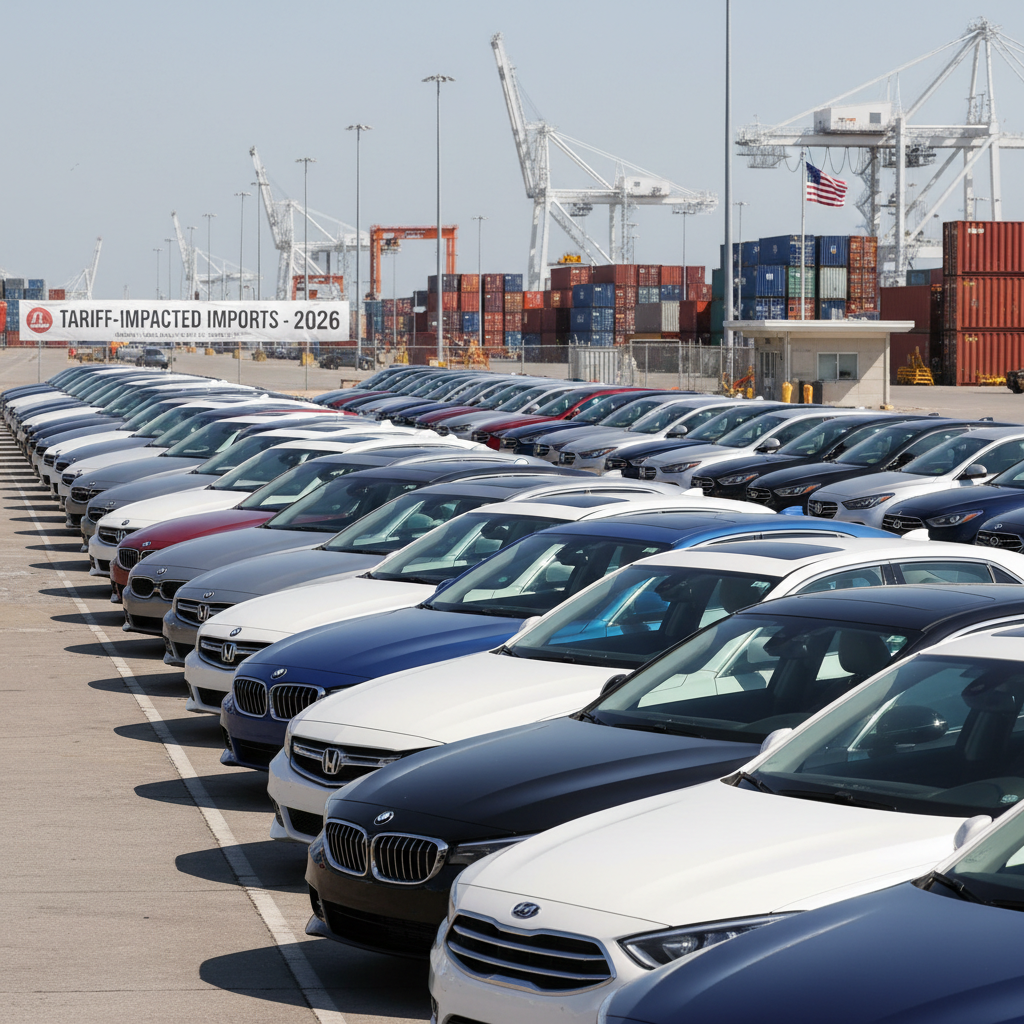
Imported vehicles at US port — Japanese and European brands face 15% tariffs under 2026 bilateral deals
Estimated Price Increase by Brand (Popular Models)
Source: Cox Automotive, Kelley Blue Book, Consumer Reports tariff analysis. Figures are estimates based on import content and tariff rates.
🔴 Most Affected Brands
- BMW / Mercedes-Benz: +$6,200–$8,100 per vehicle (Germany, 15%)
- Toyota / Honda / Nissan: +$3,500–$4,200 (Japan, 15%)
- Hyundai / Kia: +$2,900–$3,500 (Korea, 15%)
- Volkswagen / Audi: +$4,800–$7,500 (Germany, 15%)
- Volvo / Polestar: +$5,500–$9,000 (Sweden, 15%)
🟢 Least Affected Brands
- Ford F-Series: +$1,800 (Michigan/Missouri assembly)
- RAM Trucks: +$1,600 (Michigan assembly)
- Chevrolet Silverado: +$1,600 (Indiana assembly)
- Tesla Model Y: +$2,100 (California/Texas, but 40% China parts)
- Toyota Camry: +$1,900 (Kentucky assembly)
Share of US New Car Market by Tariff Exposure
Source: Cox Automotive, S&P Global Mobility. Approximately 85% of new cars sold in the US face some tariff impact.
4. New Car vs Used Car: The 2026 Decision Framework
Advertisement
The tariff shock has fundamentally changed the new vs used calculus. For most buyers — especially those with budgets under $40,000 — buying a quality used car now is the superior financial decision. Here's the data-driven framework:
Why Buying Used NOW Is the Smart Move
💡 Best Used Car Sweet Spot: 2019–2022 Toyota/Honda/Mazda with 40K–80K miles. These models offer maximum reliability, lowest repair costs, and strong resale — and tariffs won't change that.
Total Cost Comparison: Buy Used Now vs Buy New Now vs Wait
Note: "Keep Current Car" shows estimated annual maintenance cost only. Source: KBB, Cox Automotive, analyst estimates.
📊 Want to calculate your exact TCO? Use our Advanced Manual TCO Calculator to model the true 5-year cost of any vehicle including depreciation, fuel, insurance, and financing — with live market data suggestions.
5. Used Car Market: Inventory, Prices & Timing
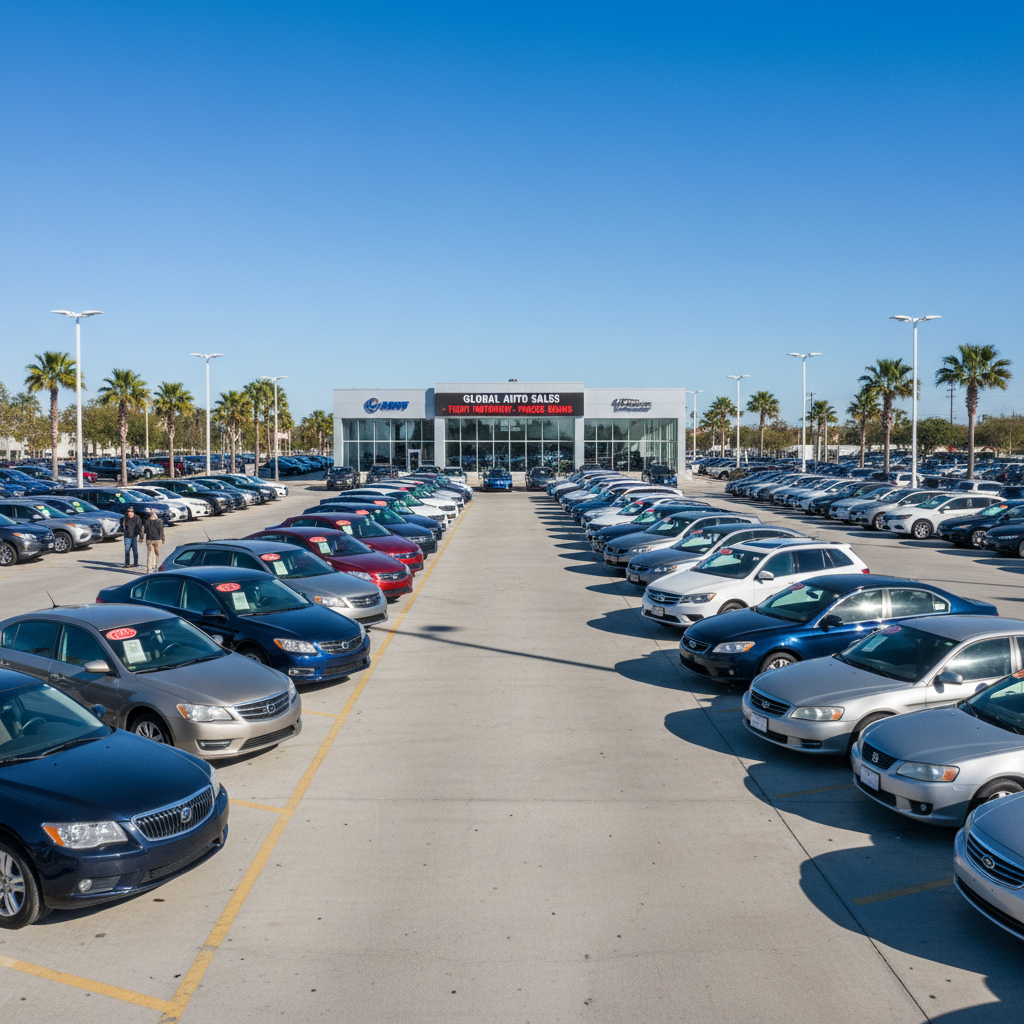
Used car inventory: 47-day supply in June 2026 — projected to tighten to 42 days by August
The used car market in 2026 is caught between two forces: tightening supply (Americans holding cars longer, fewer vehicles produced during COVID) and rising demand (budget buyers fleeing tariff-inflated new car prices). The result is a market that's stable now but will tighten significantly by Q4 2026.
Used Car Market: Days Supply & Average Price (2026)
Source: Cox Automotive, Kelley Blue Book. Jul–Aug 2026 are analyst projections. Dashed line = projected.
Top 5 Used Car Brands by Sales Volume (June 2026)
Ford, Chevrolet, Toyota, Honda, and Nissan account for nearly 50% of all used vehicles sold — unchanged from pre-tariff trends. These brands' used models remain the most available and most negotiable.
Source: Kelley Blue Book Used Car Market Report, June 2026.
6. Negotiation Tactics That Still Work in a Tariff Market
Dealers know tariffs affect the whole market — but that doesn't mean you're powerless. These tactics still deliver real savings in 2026:
Get Pre-Approved Financing Before You Visit
Visit a credit union or bank before the dealership. Pre-approval removes the dealer's financing leverage and lets you focus purely on vehicle price. Credit unions typically offer 0.5–1.5% lower rates than dealer financing.
Saves: $800–$2,400 over loan termKnow the Fair Market Value (Not Just MSRP)
Use Kelley Blue Book's Fair Purchase Price — updated weekly to reflect tariff impacts in your specific area. The MSRP is less relevant in a tariff market; what others actually paid is your benchmark.
Saves: $500–$3,000 on negotiationChallenge Every Add-On and Junk Fee
Dealer documentation fees ($400–$800), window tint, fabric protection, nitrogen tire fill, and "market adjustment" markups are all negotiable or removable. Ask for an itemized invoice and challenge each line.
Saves: $400–$1,500 per transactionBuy Mid-Month or at Quarter-End
Salespeople have monthly and quarterly quotas. Buying on the 20th–30th of the month, or in the last week of March/June/September/December, gives you leverage as dealers push to hit targets.
Saves: $300–$1,200 in flexibilityLeverage Dealer Incentives (7% of Average Deal)
Automaker incentives comprised 7% of the average transaction price in June 2026 (KBB). Research current manufacturer cash-back offers, low-APR financing deals, and loyalty/conquest bonuses before negotiating.
Saves: $1,500–$3,500 on qualifying vehiclesExpand Your Geographic Search
Dealers in lower-demand areas often have more inventory and more willingness to negotiate. Widening your search radius by 50–100 miles can reveal significantly better deals, especially on used vehicles.
Saves: $500–$2,000 vs local market7. Financing & Insurance: The Hidden Tariff Costs
The sticker price increase is just the beginning. Tariffs create a cascade of secondary costs that most buyers don't account for:
Financing Impact
- Higher loan principal: A $4,000 tariff increase on a 72-month loan at 6.5% APR adds ~$74/month and $1,328 in total interest
- Negative equity risk: 6 in 10 buyers now roll negative equity from old loans into new ones — a record high (KBB, June 2026)
- Loan term creep: Record number of new loans stretched 72+ months — lowers monthly payment but increases total cost by $2,000–$5,000
- Good news: Lenders approved 74.8% of applications in June 2026 — easiest qualification in 10+ years. Average down payment: 13.2%
Insurance Impact
- Parts tariff effect: 25% tariff on imported parts increases collision repair costs — directly raising comprehensive/collision premiums
- Replacement cost: Higher vehicle values mean higher replacement costs for total-loss claims — raising premiums 5–12%
- Insurance Information Institute: Projects insurance rates will rise to reflect elevated vehicle and parts costs throughout 2026
- Tip: Shop insurance rates BEFORE finalizing your car purchase — rates vary 20–40% between insurers for the same vehicle
📊 True Cost of a $4,000 Tariff Increase (Over 5 Years)
Assumes $40,000 vehicle, 72-month loan at 6.5% APR, $5,100/yr insurance baseline. Illustrative calculation.
💡 Related: See our Car Loan vs Cash guide and 10 Hidden Car Costs for a complete picture of what you'll actually pay.
8. Month-by-Month Buying Timeline for 2026
Related Guides & Calculators
9. FAQ: Your Top Tariff Questions Answered
Advertisement
Sources & Citations
- Kelley Blue Book — New Car Average Transaction Price, June 2026. KBB.com/tariffs. Accessed August 2026.
- Kelley Blue Book — Used Car Average Transaction Price, June 2026. KBB.com/used-car-market. Accessed August 2026.
- Cox Automotive — Tariff Impact on Vehicle Pricing: Q1–Q2 2026 Analysis. CoxAutomotive.com. Accessed August 2026.
- Consumer Reports — How to Save Money Buying a Car, Even If Prices Go Up Due to Tariffs. ConsumerReports.org. Updated July 2025.
- Kelley Blue Book — The Latest Car Tariff Information. KBB.com/tariffs. Updated February 2026.
- ConsumerAuto.us — Car Tariffs 2026: Should You Buy Now or Wait? ConsumerAuto.us. Published May 2026.
- Insurance Information Institute — Auto Insurance Rate Projections 2026. III.org. Accessed August 2026.
- S&P Global Mobility — US Auto Market Tariff Impact Analysis. SPGlobal.com. Q2 2026.
- US Trade Representative — Section 232 Automotive Tariff Details. USTR.gov. Accessed August 2026.
- Supreme Court of the United States — Ruling on IEEPA Tariffs. February 25, 2026.
This article is for informational and educational purposes only. Car prices, tariff rates, and market conditions change rapidly. Verify current data with KBB.com and USTR.gov before making purchasing decisions. Consult a financial advisor for personalized guidance.
Advertisement